- ▸ Default RTP 96.52%; operator ladder drops to 95.53% or 94.54%. Check yours.
- ▸ Pragmatic's info screen rates it medium volatility; it still feels high-variance in play.
- ▸ Hit frequency about 42.91%, so roughly 1 in 2.33 spins returns something.
- ▸ The base game pays small and often; the free-spins bonus is rare (about 1 in 450) and carries the ceiling.
- ▸ Per-mode RTP shifts a hair by bet type: Ante Bet 96.49%, Super Spin 96.50%, buys 96.50-96.51%.
Reviewed game
 Sweet Bonanza 2500 (Pragmatic Play)
Play the game
18+ | T&C apply | Play responsibly
Sweet Bonanza 2500 ships a default 96.52% RTP, but operators can run it lower (95.53% or 94.54%). Pragmatic's own info screen calls it medium volatility, though the rare bonus and 25,000x ceiling make it play high-variance. It pays something about 42.91% of spins - roughly one in 2.33 - yet the big money hides in a rare bonus. Here is what the numbers actually mean for a real bankroll.
The short answer: 96.52% return on a swingy ride
The default RTP is 96.52%, and Pragmatic Play ships the same game on a downward ladder that operators pick from: 96.52% / 95.53% / 94.54%. So the return your casino advertises is a choice the operator made, not a fixed number, and you want to check it before you load a single spin. Volatility is where people get tripped up. The in-game info screen calls it medium, yet it plays like a high-variance slot because the payouts sit in two very different places. Something pays on about 42.91% of spins, roughly 1 in 2.33, but most of those are small, and the money that matters hides in a bonus that lands about 1 in 450 spins.
You should read the two numbers together, not apart.
Key takeaways
The RTP ladder and why the operator build decides your odds
Start with the headline. At its top setting, Sweet Bonanza 2500 returns 96.52% of wagered money over a very long run, which is a solid figure for a modern Pragmatic slot. The catch is that Pragmatic hands operators three approved builds, and a casino can legally run the 95.53% or 94.54% version instead. That difference sounds tiny on paper. Over thousands of spins it is not: a full two percentage points of house edge is real money leaving your bankroll faster, and you never see which build you're on unless you open the game's own info screen and read the theoretical RTP line.
So the single most useful habit here has nothing to do with strategy. Open the rules panel, find the RTP figure, and if it reads 94.54% when a competing casino runs 96.52%, play the higher one. That's the whole trick.
What Pragmatic's own RTP panel shows
The figures below come straight off the in-game Game Rules screen, captured while we ran the free demo. This is a primary source, so it settles the per-mode question that affiliate copy usually gets wrong. Each bet type carries its own theoretical RTP, and they cluster within a few hundredths of the 96.52% default.
Per-mode RTP from the panel
- Ante Bet: 96.49%
- Super Spin: 96.50%
- Buy Free Spins: 96.50%
- Buy Super Free Spins: 96.51%
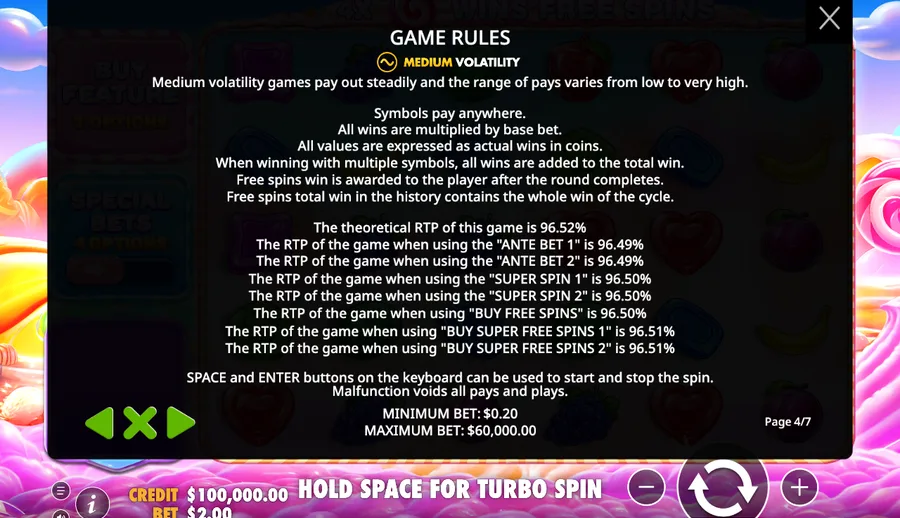
RTP by mode, at a glance
Here's the ladder and the per-mode splits in one place. The value cells are the numbers you actually want to compare when you sit down.
| Setting or mode | Theoretical RTP |
|---|---|
| Default (top operator build) | 96.52% |
| Operator ladder, middle | 95.53% |
| Operator ladder, lowest | 94.54% |
| Ante Bet mode | 96.49% |
| Super Spin mode | 96.50% |
| Buy Free Spins | 96.50% |
| Buy Super Free Spins | 96.51% |
The mode figures barely move, so switching to Ante or a buy doesn't quietly cost you return. The build your casino chose is the only lever that matters, which is why we keep repeating it.
Medium volatility that plays high-variance
Pragmatic's own info screen calls it medium volatility, though the rare bonus and 25,000x top make it feel high-variance in play. That gap is worth understanding before you set a stake. A medium label reflects the average across every spin, and the base game does pull that average up by paying small amounts often. But your session isn't an average. You'll ride long stretches where nothing much happens, then a tumble chain or a bonus swings hard.
Third-party trackers often disagree with the panel and tag the game high or very high. They're not wrong about the feel. When a slot's ceiling is the 25,000x max win and the big money only arrives in a bonus that shows up about once every 450 spins, the ride is bumpy no matter what the summary label says. Treat it as high-variance for bankroll purposes and you won't be caught out.
Where the base game pays
Small and steady. Across the demo spins we played, base-game wins mostly landed in the 0.5x to 3x band on a small, unscientific sample. Those keep the reels warm and the hit frequency high at about 42.91%, but they rarely clear the cost of the losing spins around them. This is the drip that makes a session last, not the part that makes it memorable.
Where the ceiling lives
In the free spins. Candy bomb multipliers from x2 up to x2,500 sum across a tumble sequence and apply at the end, so a monster round happens only inside the bonus. That bonus triggers roughly 1 in 450 spins on Pragmatic's spec, which is why long dead stretches are normal and why the 25,000x figure is a genuine long shot rather than a target.
What the maths mean for a real session
Numbers on a spec sheet don't tell you how a night feels. This table translates them into what you should actually expect at the reels, so you can size a bankroll that survives the quiet patches.
| What the number is | Figure | What it means for your session |
|---|---|---|
| Hit frequency | 42.91% (1 in 2.33) | Something pays on nearly half of spins, but most are small, so a frequent hit is not a winning hit. |
| Free-spins trigger | about 1 in 450 | Plan for hundreds of base spins between bonuses; budget so you can reach one without going bust. |
| Max-win odds | 1 in 66,722,269 | The 25,000x is real but effectively a lottery line - never a plan. |
| Default RTP | 96.52% | Expect to lose about 3.48c per dollar over the long run at the top build; more on a lower one. |
Bankroll discipline for a swingy slot
Treat the medium label with suspicion and stake as if it's high-variance, because in practice it is. A workable rule is to keep your base bet small enough that a couple of hundred dead spins won't end the session before a bonus can land. Set a loss limit before you start and a walk-away point if you hit a good bonus, since the game is built to hand a win back through the same tumble loop that gave it. The only edge you control is the build: play the demo first to learn the rhythm, then pick the 96.52% version over a 94.54% one every time. Nothing about stake size, timing or spin speed changes a licensed RNG's odds - only the RTP build and your discipline do.
Honest cons on the RTP and variance
The return is fine, not generous. 96.52% is solid, but it's the top of a ladder, and plenty of casinos quietly run the 95.53% or 94.54% build, which means the number you get depends entirely on where you play. The variance is the harder pill. A medium rating undersells the long dead stretches; the money is locked behind a roughly 1-in-450 bonus, so a casual bankroll can drain before the game ever shows its good side.
Our named anti-recommendation is blunt: don't play a 94.54% build if you can find the 96.52% one elsewhere. That's a full two points of house edge for the same game, and no session strategy claws it back. If a lower build is all your casino offers, spend your money where the return is higher or stick to the Sweet Bonanza 2500 demo until you find a better one.
Play the higher-RTP build
Want the real-money version? Check the RTP in the game's info screen first, then play where it reads 96.52%. If you're still learning the tumble rhythm, try how Sweet Bonanza 2500 works, or dig into the 25,000x max win before you stake. For the full review and our 8.0/10 verdict, head back to the Sweet Bonanza 2500 homepage.